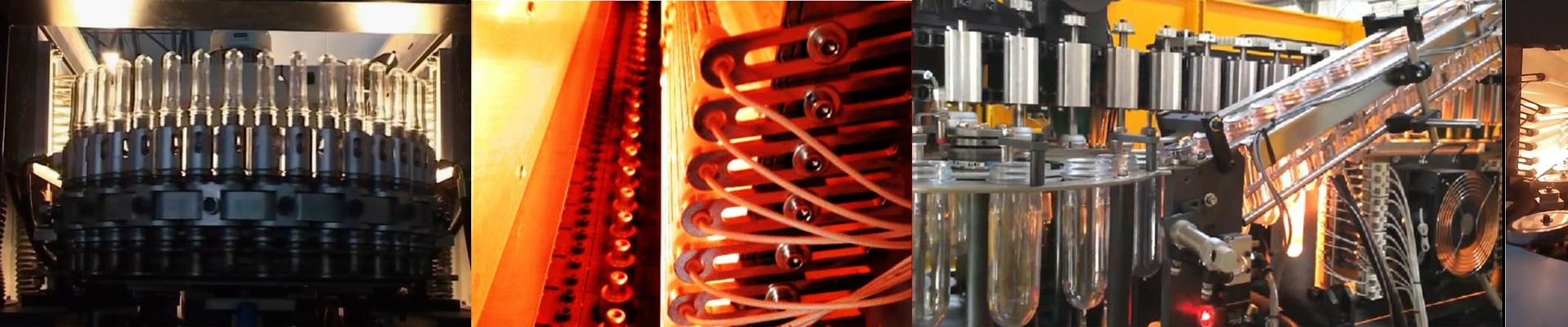
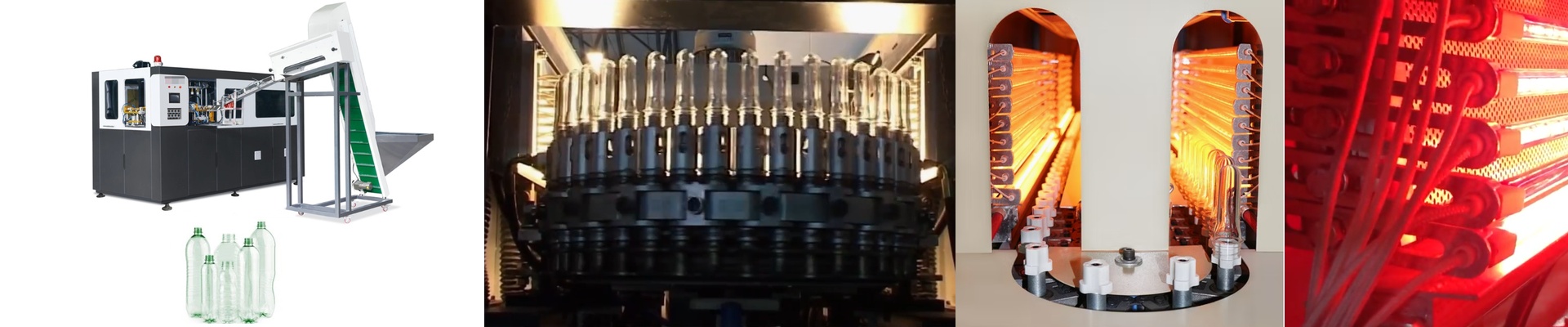
When an Engel heater fails on the blow molder, it doesn’t care about shift change or production schedules. Preforms come up cold, stretch blow molding cycles start to drift, and you start watching good bottles get scrapped for clarity issues, uneven wall distribution, and neck stress. A weak heating tunnel costs you in scrap, restarts, and electricity that isn’t turning into sellable product.
What actually matters, technically
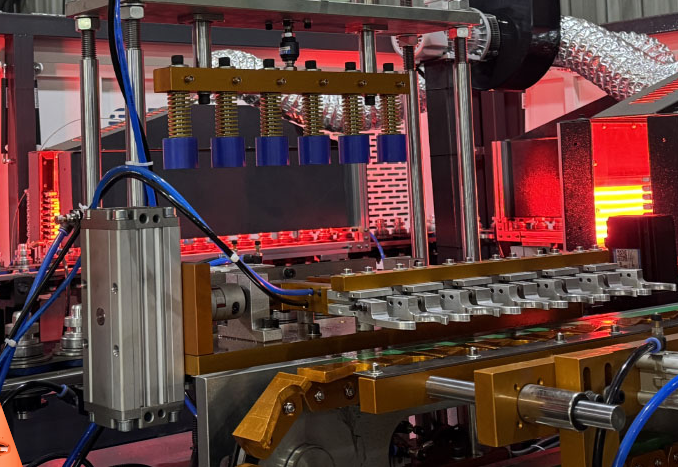
We build the replacement using spec-matched infrared emitters for Engel blow molders: quartz envelope, halogen/tungsten filament, and a heating curve that keeps the preform heating zone under control. Expect 230–240V operation, with power matched to the original heater segment—typically 1.0–1.5 kW per emitter. The physical interface is engineered to OEM-equivalent dimensions and mounting, whether that’s an R7s bayonet or the exact fixture your heating tunnel uses. The real lever is spectral output and response time. The emitter has to hit target preform surface temperature fast, then hold it without hanging on and overshooting. That’s what keeps stretch blow molding repeatable, shot after shot.
Why this approach holds up on the line
You’ll get back to setpoint quicker after startup, and the heating across the preform body stays stable. That means fewer pinholes, cleaner biaxial stretch, and less variation in bottle weight. Because the output is matched to the original design, you don’t throw off the heating zone balance and end up chasing hot and cold spots by over-compensating elsewhere. The payoff is practical: more uptime, fewer stops tied to heater issues, and energy use that stays closer to baseline because the system isn’t fighting mismatched lamps.
The details that trip people up
Matching wattage and envelope is only half the job. If the reflector condition, thermal insulation, or airflow around the heating tunnel are off, even the correct lamp will run hotter than it should. Before you swap, verify voltage at the connector, check for oxidized socket contacts, and make sure the thermocouple/sensor reading is calibrated. If your Engel machine runs in higher ambient temperatures or in humid wash-down areas, specify the right sealing and anti-condensation measures. Keeping the lamp end-cap and wiring dry is the difference between a fix that lasts and one that comes back as next shift’s headache.