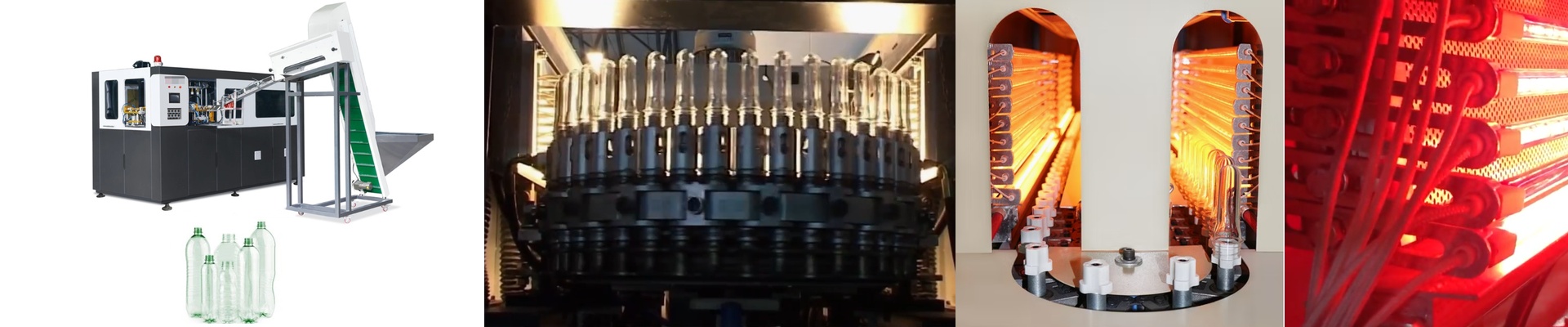
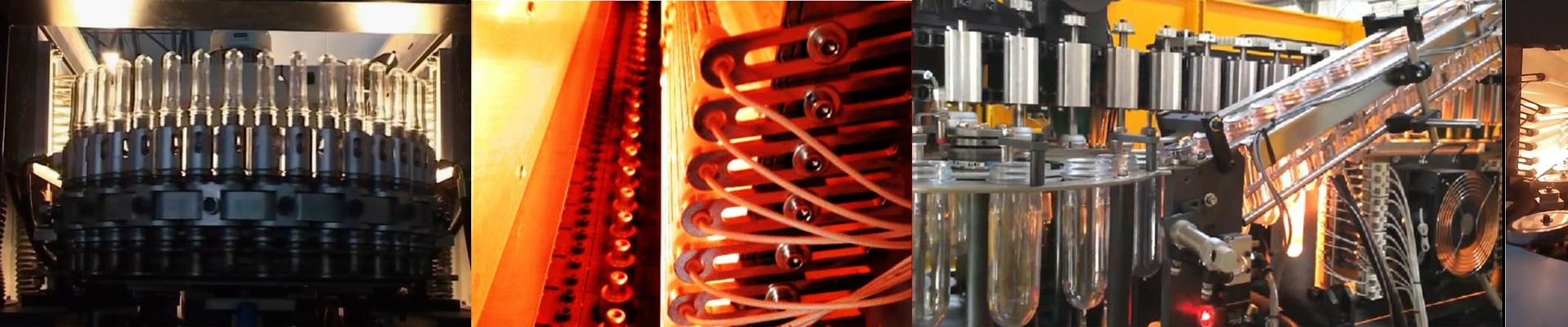
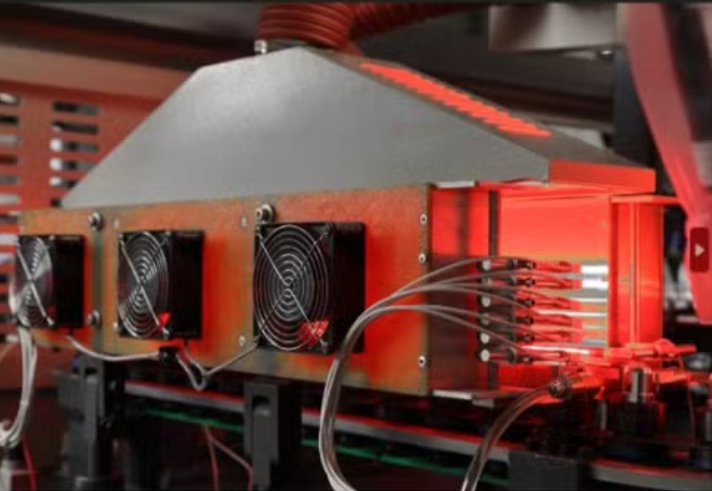
On the blow molding floor, the heating tunnel is where the whole schedule lives or dies. If preforms come out uneven—neck too hot, shoulder still cool—you’re asking for thin spots, flash, or a stretch that doesn’t lock in strength. And when the lamps are underperforming, the oven tries to compensate by running hotter. You end up paying for the energy, but you’re not fixing the root issue. Infrared lamps in a PET oven aren’t just another consumable. They’re the calibrated heat source that makes repeatability, cycle time, and scrap numbers possible. We supply infrared lamps built as direct replacements for PET ovens on blow molding platforms—Sidel, Krones, SIPA, Husky, SACMI, and Nissei ASB. The idea is straightforward: match the OEM electrical and thermal parameters, and the machine gets back to the heating profile it was designed to run.
What actually matters, technically
In PET stretch blow molding, infrared heating is about delivering predictable radiant power into the preform wall. The lamps we build are specified around the realities of the heating tunnel: fast response, stable output, and consistent termination.
- **Wavelength selection (Short Wave / NIR, Medium Wave, Carbon):**PET absorbs strongly in the near-infrared range. Short-wave infrared (NIR) emitters deliver high radiant intensity with fast on/off response, which helps keep temperature control tight during short dwell times. Medium-wave quartz and carbon filament lamps give you deeper thermal penetration and can even out thicker preform zones. We match wavelength to preform geometry and the oven’s reflector layout so the energy lands where it needs to.
- **Power density and output:**Oven zones are designed around a specific heat flux. We supply lamps in the watt densities used across OEM ovens—commonly 1.0 kW to 3.0 kW per emitter—so zone power stays within the original machine envelope. Output is specified at the filament temperature that produces the intended spectral distribution, not at marketing numbers.
- **Voltage, current, and tolerance:**The lamp has to accept the oven’s control voltage without shifting the heating curve. We offer 120 V and 230 V configurations as standard, with current matched to the socket and wiring. Tight tolerances on resistance and operating current prevent cascading issues in SSRs and PID loops.
- **Physical envelope and connections:**The lamp has to fit—plain and simple. We build to the standard lengths and diameters used in PET oven assemblies, including common end-cap types and R7s connectors. Dimensions are held to ±2 mm on length and ±1 mm on diameter so the lamp seats cleanly in the reflector and aligns with the focal line.
- **Materials and thermal cycling:**PET oven lamps live through repeated heat-up and cool-down. We use quartz envelopes with high thermal shock resistance and internal filament structures designed for repeated cycling. In practice, that means fewer hard failures and less output drift over time.
Why this matters on a blow molding line
The oven doesn’t run in isolation—it feeds the stretch blow step. If preform temperature is off, parison thickness distribution shifts, and the bottle starts failing proof or top load. If you chase temperature by cranking up setpoints, you increase crystallinity risk and draw more energy for no real gain. Our infrared lamps are specified to restore the original heating balance.
- **OEM-aligned performance:**We match the parameters that define the heating profile—voltage, wattage, spectral output, and physical placement. That keeps the temperature spread across preforms within the window the blow molder was designed to accept, tight enough to avoid brittle neck crystallization while still giving uniform wall distribution.
- **Fast response, stable cycles:**Infrared lamps heat on demand. With fast-response emitters, you cut down on overshoot when zones cycle, which stabilizes the heating tunnel and supports consistent cycle times.
- **Lower energy draw per usable heat:**Infrared transfers energy directly to the preform surface, not to the air. When lamps are in spec, the oven doesn’t have to run hotter to compensate for weak emitters. In many plants, that shows up as a measurable reduction in kWh per thousand bottles, especially when replacing aged or mismatched lamps.
- **Fewer lamp changes, less downtime:**We design for service life that can keep up with high-duty oven cycles. In typical 24/7 blow molding operation, it’s realistic to see thousands of hours between lamp replacements when the lamp matches the zone duty and the electrical system is stable. Fewer swaps means fewer interruptions—and fewer restarts that generate startup scrap.
- **Drop-in replacement across major platforms:**Whether your line runs Sidel, Krones, SIPA, Husky, SACMI, or Nissei ASB, the goal is the same: replace the emitter and keep machine behavior unchanged. We supply lamps built to the connector type, envelope size, and power profile used in those ovens, so installation is straightforward and the heating map stays consistent.
The practical details you can’t skip
Even the best infrared lamp is only as reliable as the system it runs in. Here are the real-world points to handle before you order and during installation.
- **Check the socket and wiring condition:**High heat bakes sockets and oxidizes contacts. If the socket is pitted or discolored, replace it. A solid connection matters—loose contacts raise resistance, create hot spots, and can kill a lamp early.
- **Confirm the control method:**Some ovens drive lamps directly; others use SSRs or transformers. Match the lamp to the control method. If you switch from halogen to carbon, or from medium wave to short wave, without adjusting the control strategy, you can shift thermal response and introduce temperature drift.
- **Keep reflectors clean and aligned:**Reflectors lose effectiveness when they’re coated with dust and polymer residues. Clean them before installing new lamps. A misaligned lamp changes the focal line and creates uneven heating, which shows up as inconsistent bottle weight and wall thickness.
- **Stay within operating temperature limits:**Quartz and filament components have thermal limits. Run the lamp within its rated voltage and temperature range. Overdriving a lamp shortens life fast—and can damage the socket and wiring.
- **One real trade-off—lamp type versus preform changeover:**Short-wave NIR lamps respond quickly and suit thin-wall, fast-cycle jobs. Medium-wave and carbon lamps can be more forgiving on thicker preforms and heavy color loads. If you run frequent preform changes—clear, white, green, wide neck, narrow neck—you may need a different lamp profile for each product family to keep the heating window tight. Plan your inventory accordingly. If you’re buying infrared lamps for a PET oven, you’re not just buying a bulb. You’re buying repeatability back into the heating tunnel. Give us the blow molder model, oven zone layout, and your current lamp specs, and we’ll supply wholesale infrared lamps that match the OEM parameters—so your line runs the same tomorrow as it did yesterday.